By Your Partners DC | Washington's Top Real Estate Team
Dupont Circle rewards people who like to explore a neighborhood on foot. Within a relatively compact part of Northwest Washington, you can move from a shaded public park to an independent bookstore, a private art collection, an Embassy Row mansion, and dinner inside a historic rowhouse. That mix of culture, dining, architecture, and everyday convenience is why the neighborhood appeals to weekend visitors as well as people considering a home in central DC.
This Dupont Circle neighborhood guide focuses on places that reveal the character of the area rather than simply filling an itinerary. Because restaurant hours, museum access, and reservation policies can change, it is always wise to confirm details directly before visiting. The good news is that Dupont Circle offers enough variety to keep a weekend flexible, whether you plan around a museum reservation or simply begin at the fountain and see where the day leads.
Getting Oriented in Dupont Circle
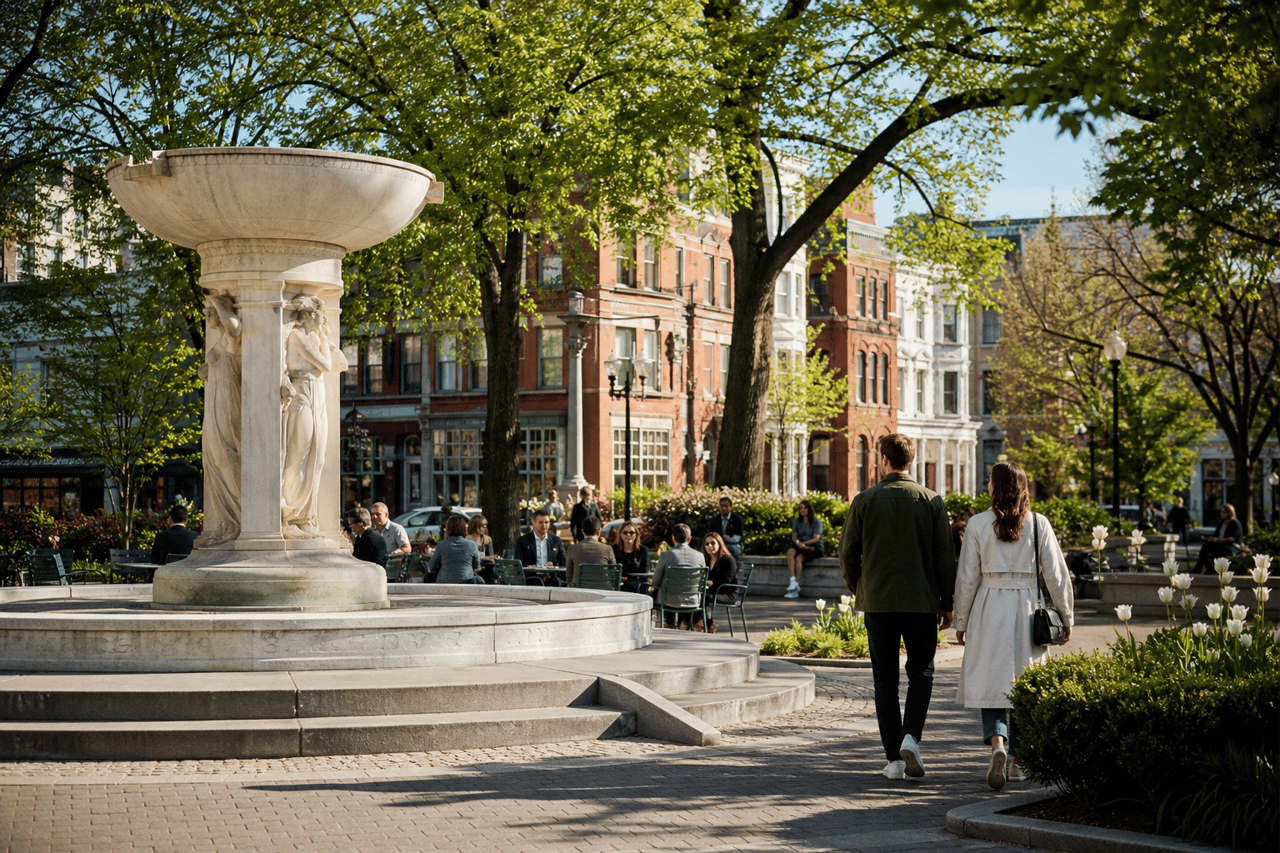
The traffic circle itself is the neighborhood’s natural starting point. Its central park, managed by the National Park Service, is a familiar gathering place with benches, mature trees, and the Daniel Chester French fountain at its center. Connecticut Avenue runs north and south through the area, while Massachusetts Avenue heads northwest toward Embassy Row, giving visitors several distinct directions to explore.
The Dupont Circle Metro station on the Red Line has entrances north and south of the circle, making the neighborhood accessible without a car. From here, much of the experience unfolds within a comfortable walk, although the terrain becomes hillier toward Kalorama. Capital Bikeshare, buses, and bike lanes provide additional options, but walking is often the best way to notice the architectural details, pocket parks, galleries, and converted rowhouses that define the area.
Dupont Circle does not have one uniform commercial strip. Restaurants and shops are distributed along Connecticut Avenue, P Street, 17th Street, 18th Street, and the smaller blocks between them. That pattern is part of the neighborhood’s appeal: the most memorable places are often located a block or two away from the circle rather than directly on it.
Where to Eat in Dupont Circle
Start With Coffee, Tea, or a Casual Breakfast
For an unhurried start, Emissary on P Street is a neighborhood coffeehouse with food and seating that works well before a day of walking. Nearby, Bagels Etc. is a compact, longstanding option for a straightforward bagel breakfast. Teaism, tucked into a rowhouse on R Street, offers tea and Asian-influenced dishes in a setting that feels especially suited to a quiet morning.
These smaller establishments illustrate an important part of daily life in Dupont Circle. Despite the neighborhood’s central location, residents can still find independent, informal places that function as regular stops rather than special-occasion destinations. On busy weekends, arriving earlier usually provides a more relaxed experience, particularly when outdoor seating is in demand.
Make Lunch Part of the Neighborhood Experience
Kramers is an easy place to combine lunch with browsing. The independent bookstore has been part of the neighborhood for decades, and its café allows visitors to linger rather than treating the shop as a quick stop. Its location near the circle also makes it a practical midpoint between the Phillips Collection, Embassy Row, and the shops around P Street.
For a different style of meal, ala on 19th Street serves cuisine inspired by the Levant, while CHIKO on P Street brings together Chinese and Korean culinary influences in a more casual format. Both demonstrate how internationally oriented dining fits naturally into Dupont Circle. The neighborhood’s proximity to embassies, universities, offices, and cultural institutions has long contributed to a dining scene that reaches beyond standard American fare.
Plan Ahead for Dinner
Iron Gate on N Street is particularly atmospheric, with Mediterranean-influenced dining in a historic setting and an intimate garden area. Floriana serves Italian food in a colorful rowhouse on 17th Street, while Hank’s Oyster Bar on Q Street is a familiar destination for seafood. Agora, also on 17th Street, is another option for Mediterranean and Turkish flavors in the southern part of the neighborhood.
The setting can matter almost as much as the menu here. Several Dupont Circle restaurants occupy narrow rowhouses, garden spaces, or older commercial buildings, creating dining rooms that feel connected to the neighborhood’s architecture. Reservations are sensible for popular dinner periods, especially on Friday and Saturday evenings, and outdoor tables can be highly sought after in mild weather.
For a drink after dinner, the hotels and bars around the circle offer options ranging from polished lounges to casual neighborhood gathering places. Doyle, inside The Dupont Circle hotel, overlooks the circle and offers a more refined atmosphere. As anywhere in central DC, hours and access can vary for private events, so checking directly before making it the final stop of the night is worthwhile.
Where to Shop and Browse
Dupont Circle is better for distinctive browsing than for large-scale retail. Kramers is the best-known independent bookstore in the immediate neighborhood, with a broad selection and the convenience of an attached café. Second Story Books on P Street is a rewarding stop for used, rare, and out-of-print books, and its densely stocked interior invites the kind of slow browsing that works well on a weekend.
Other neighborhood shops serve specific interests. Fantom Comics on P Street caters to comics and graphic-novel readers, while Tabletop on 20th Street carries games, gifts, and design-oriented items. Together, these businesses give the retail scene a personal, locally rooted quality that differs from the national-brand shopping found in larger commercial districts.
That distinction matters for prospective residents. Dupont Circle offers useful daily services and enjoyable specialty shopping, but it is not a conventional shopping destination or suburban town center. People who want major department stores or a broad concentration of apparel retailers will often travel to Georgetown, CityCenterDC, or nearby suburban destinations, while Dupont excels at places that can become part of a weekly routine.
Art, Architecture, and Local Culture
The Phillips Collection at 21st and Q streets is one of the neighborhood’s defining cultural institutions. Its galleries occupy a combination of the historic Phillips house and later additions, creating a museum experience that feels more intimate than the monumental museums on the National Mall. It is especially well suited to a focused morning or afternoon visit rather than a rushed stop between other attractions.
A walk northwest along Massachusetts Avenue introduces Embassy Row, where diplomatic buildings and grand residences create one of Washington’s most architecturally distinctive streetscapes. Anderson House, home to the Society of the Cincinnati, offers another window into the area’s history and decorative arts when tours and exhibitions are available. Public access to embassies themselves is generally limited, but the avenue is still worthwhile for its architecture and urban landscape.
The Heurich House Museum near New Hampshire Avenue preserves the late-19th-century home of brewer Christian Heurich. Its interiors and programs provide useful context for understanding the people, craftsmanship, and domestic architecture associated with Washington’s growth. Tour schedules can be limited, so this is one stop that benefits from advance planning.
If you want to extend the walk, continue toward Kalorama and the Spanish Steps, a small terraced landmark connecting S Street with Decatur Place. The route becomes noticeably hillier and more residential as it leaves the commercial core. That transition offers a clear sense of how quickly Dupont Circle’s energetic sidewalks give way to quieter streets, embassies, and substantial historic homes.
How to Spend a Weekend in Dupont Circle
Saturday: Books, Art, and a Rowhouse Dinner
Begin Saturday with coffee or breakfast near P Street, then walk to the Phillips Collection before the middle of the day. Afterward, browse Kramers and Second Story Books, leaving time to explore the residential blocks between 20th, 21st, Q, and R streets. These streets reveal a side of Dupont Circle that visitors miss when they remain on Connecticut Avenue: bay-fronted rowhouses, apartment buildings from different eras, small gardens, and surprisingly quiet sidewalks.
Spend the late afternoon walking along Massachusetts Avenue or visiting Anderson House if its current schedule aligns with your plans. Dinner at Iron Gate, Floriana, Hank’s Oyster Bar, or another neighborhood restaurant allows you to experience how Dupont’s historic building stock shapes its hospitality scene. Finish with a drink near the circle, or take an evening walk through the park when the surrounding restaurants and hotels give the area a livelier urban feel.
Sunday: The Farmers Market and a Longer Walk
On Sundays, the FRESHFARM Dupont Circle Market near 20th and Q streets is a neighborhood institution. Vendors and operating hours can vary by season, so consult FRESHFARM’s current schedule before visiting. The market is not only a place to shop for food; it also shows how residents use public space and how strongly walkability influences daily routines in this part of Washington.
After the market, have brunch or a casual lunch and choose between a cultural stop and a longer neighborhood walk. Heading north toward Kalorama and the Spanish Steps highlights the area’s topography and residential architecture, while walking south along 17th Street leads past restaurants and rowhouses toward Logan Circle. Either route helps place Dupont within the broader network of central DC neighborhoods rather than treating the circle as an isolated attraction.
What It Is Like to Live in Dupont Circle
Living in Dupont Circle generally means trading suburban space for access, architectural character, and a highly walkable daily routine. The housing stock includes converted rowhouse condominiums, larger prewar apartment and cooperative buildings, contemporary condominiums, and a more limited number of complete rowhouses. Two properties with similar square footage can feel very different depending on ceiling height, natural light, elevator access, outdoor space, building services, and whether parking is included.
Older buildings are a major part of the neighborhood’s charm, but they require careful evaluation. Buyers should pay attention to windows, masonry, plumbing, electrical systems, sound transfer, central air conditioning, and any past alterations. In condominiums and cooperatives, the building’s financial condition, reserve planning, insurance, rules, upcoming projects, pet policies, and rental restrictions may be just as important as the condition of the individual unit.
Historic-district considerations can also affect renovation plans, particularly when proposed work changes an exterior feature visible from a public street or alley. A project involving windows, roofs, additions, or façades may require more review than a buyer expects. Before assuming a renovation is feasible, purchasers should investigate applicable DC permitting, preservation, and association requirements with qualified professionals.
Transportation is one of Dupont Circle’s clearest lifestyle advantages. The Red Line provides direct service toward downtown, Union Station, Cleveland Park, and Bethesda, while buses, bikeshare, and walkable streets expand the range of practical commutes. Parking, however, varies significantly by property, and residential permits do not guarantee a convenient curb space. Buyers who rely on a car should evaluate garage or deeded parking, alley access, loading logistics, and the actual parking conditions at the times they expect to be home.
The experience also changes from block to block. A condominium facing Connecticut Avenue may offer immediate access to restaurants and Metro but experience more activity and street noise, while a unit on a side street may feel markedly quieter. Weekend nightlife, trash collection, restaurant deliveries, and construction are worth observing in person rather than trying to assess solely from a daytime showing.
Dupont Circle Compared With Cleveland Park, Capitol Hill, and Bethesda
Dupont Circle’s housing and lifestyle differ meaningfully from other sought-after parts of the Washington region. Cleveland Park offers Red Line access and historic architecture but generally feels more residential, with detached and semi-detached homes mixed among apartment and condominium buildings. Capitol Hill is known for long stretches of rowhouses and a neighborhood pattern shaped by Eastern Market, the Capitol complex, and several Metro stations, while Dupont places residents closer to downtown offices, Embassy Row, and a dense concentration of restaurants and cultural destinations.
Bethesda provides an especially useful comparison for buyers considering both DC and Maryland. Downtown Bethesda offers a walkable urban core, Metro access, restaurants, newer condominium options, and proximity to larger residential neighborhoods, but it does not replicate Dupont Circle’s concentration of historic rowhouses, embassies, and central-city institutions. Buyers may also encounter different contract practices, disclosures, property-tax structures, condo or HOA documentation, and settlement considerations in Maryland than in the District, making locally experienced real estate and settlement professionals important.
The right choice is usually less about declaring one location better and more about understanding the daily routine each supports. A buyer who wants to walk to museums, restaurants, and central DC offices may prioritize Dupont Circle, while someone who needs more interior space, newer construction, or easier access to destinations in Montgomery County may prefer Bethesda. Comparing actual properties, commute patterns, monthly ownership costs, and weekend habits is more useful than comparing neighborhood names alone.
Is Dupont Circle Right for You?
A weekend in Dupont Circle can tell you quite a bit about living here if you pay attention to more than the attractions. Walk from the Metro to a prospective block, visit in both daytime and evening, and note where you would buy groceries, exercise, meet friends, and park if needed. Those practical observations often reveal whether the neighborhood’s energy and convenience fit your routine.
For sellers, the same details help shape an effective marketing strategy. Buyers are not only purchasing a residence; they are evaluating the building, block, transit access, historic character, and ability to participate in one of Washington’s most established urban neighborhoods. Thoughtful positioning should explain those advantages while being transparent about property condition, association responsibilities, parking, and renovation constraints.
If you are considering buying or selling in Dupont Circle, Cleveland Park, Capitol Hill, Bethesda, or elsewhere around Washington, DC, connect with Your Partners DC. Our team can help you compare neighborhoods, understand the local housing stock, and make a confident real estate decision based on how you actually want to live.