By Your Partners DC | Your Washington, DC–Area Real Estate Experts
If you’re planning a December outing in Northwest DC, make ZooLights 2026 the centerpiece of an evening in Cleveland Park. Take the Red Line, walk south along Connecticut Avenue, have dinner near the station, and leave time to enjoy the neighborhood as well as the lights. The Smithsonian has scheduled ZooLights for December 26–30, 2026, and January 2–3, 2027, so there are options after Christmas—but not on New Year’s Eve or New Year’s Day. Admission requires a separate ZooLights ticket, even if you have a pass for a daytime Zoo visit.
When is ZooLights open after Christmas in 2026?
According to the Smithsonian’s announced schedule, the post-Christmas dates are Saturday, December 26, through Wednesday, December 30, followed by Saturday, January 2, and Sunday, January 3, 2027. ZooLights runs from 5 to 9 p.m. Monday through Saturday, with last entry at 8:30 p.m. On Sundays, including January 3, it runs from 5 to 8 p.m., with last entry at 7:30 p.m. Those are admission cutoffs, not suggested arrival times; entering with half an hour left would give you little time to explore.
The ZooLights event page lists general admission at $10 per person. Everyone age 3 or older needs a ticket, while children 2 and younger enter free. Capacity is limited, and the Zoo encourages advance purchases; tickets are nonrefundable, and exchanges up to 48 hours before the event are subject to availability. Buy through the Smithsonian rather than a third-party seller, and check the event page again when you choose a date in case availability or arrangements have changed.
How do you walk from Cleveland Park Metro to ZooLights?
Exit Cleveland Park station on the Red Line and head south on Connecticut Avenue NW, toward Macomb Street and the Zoo. You’ll pass the neighborhood’s restaurant and shopfront blocks before continuing to the Zoo’s main pedestrian entrance at 3001 Connecticut Avenue NW. The Smithsonian puts the walk from Cleveland Park station at about half a mile. Allow more time if you’re stopping for dinner, walking with a group, or navigating busy crossings after dark.
The direction matters. Cleveland Park station is north of the Zoo, so the approach along Connecticut Avenue avoids the moderate uphill walk from the Woodley Park–Zoo/Adams Morgan station that the Smithsonian notes in its transit guidance. Inside the gates, however, the Zoo itself is hilly: its ZooLights map places the Connecticut Avenue entrance at the upper end of Olmsted Walk and the Harvard Street entrance at the lower end. Think about the return trip before you set off downhill, particularly if anyone in your party would find the climb back difficult.
For a less walk-heavy approach, the Zoo identifies the D70 Metrobus as stopping directly in front of its Connecticut Avenue entrance. Check your route and return service through WMATA’s rider tools shortly before leaving; holiday-period service and evening arrival times are worth confirming rather than assuming.
Where should dinner fit into a Cleveland Park ZooLights evening?
For the simplest itinerary, eat before entering the Zoo. Medium Rare, at 3500 Connecticut Avenue NW, is near Cleveland Park station and gives you a sit-down dinner option before the walk south. Spices, at 3333 Connecticut Avenue NW, is another option along the corridor, closer to the Zoo-bound part of the walk. Both businesses publish their locations and regular dinner hours, but confirm holiday-week hours and availability directly before building your ticketed evening around either one.
An early meal leaves room for an unhurried visit once the gates open at 5 p.m. If you’d rather go straight to the lights, the Zoo lists food and drinks for purchase during the event, including hot cocoa and seasonal treats. Check the current offerings before relying on them for a full dinner. The practical advantage of keeping your plans flexible is that you can spend more time on the illuminated route without having to rush back uphill for a reservation.
What will you see at the National Zoo holiday lights?
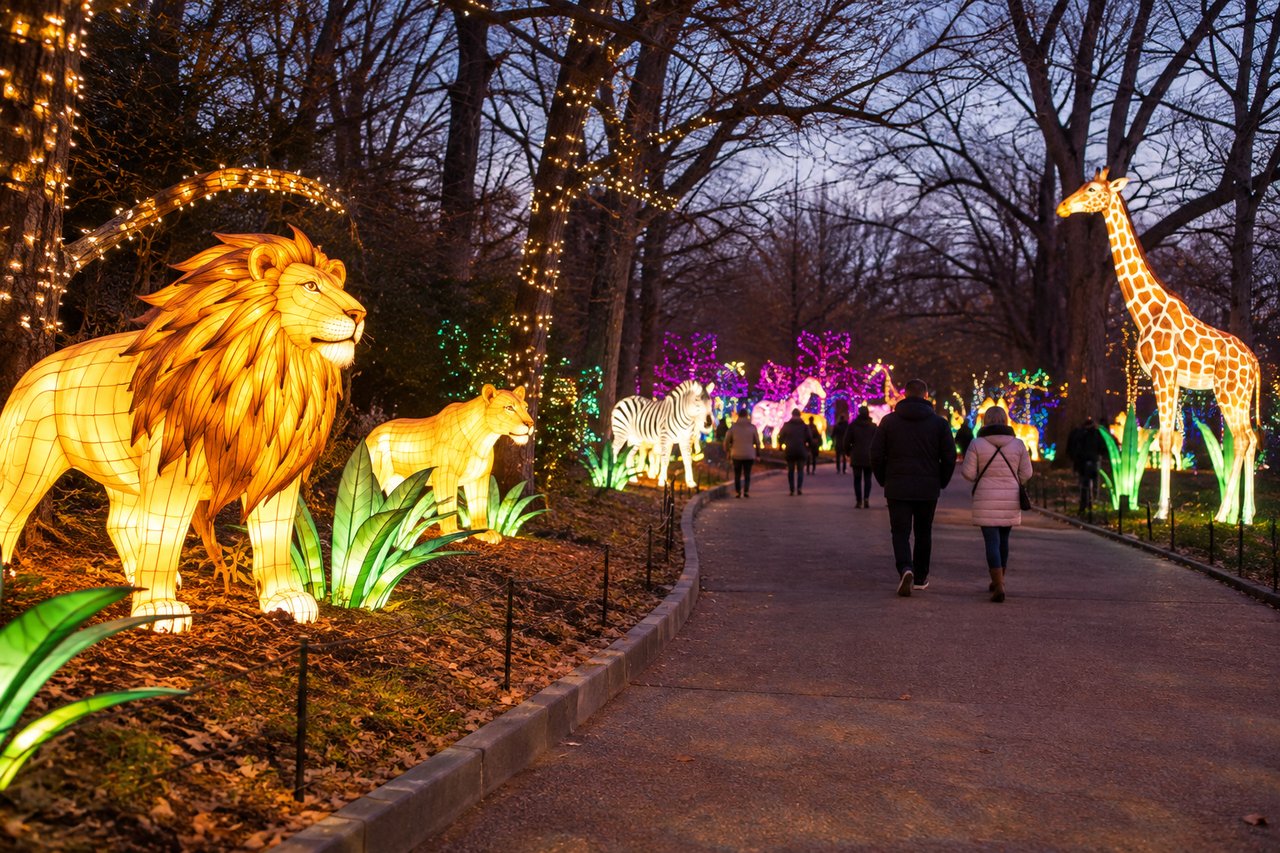
ZooLights follows Olmsted Walk, the main route between the Connecticut Avenue and Harvard Street entrances. Starting at the upper entrance, the event map leads visitors through Ocean and Desert displays, then Rainforest, Grassland, and Polar areas farther downhill. The Smithsonian says the installation includes more than 100 animal and habitat lanterns alongside its light displays. It’s worth opening the map before you go, both to get a sense of the route and to locate restrooms and food stops.
Plan for an outdoor light walk rather than a nighttime tour of animal houses. On general-admission ZooLights nights, indoor animal exhibits are closed and most outdoor animals will be resting. The light maze, train, and carousel are separately priced attractions, and the carousel is weather-dependent. If a particular add-on matters to your group, check its availability and cost when you book instead of treating it as part of the admission ticket.
The event takes place in rain, snow, or shine, so comfortable shoes and warm layers make more difference than an elaborate itinerary. The Zoo says it will announce a severe-weather cancellation by 2:30 p.m. on its website. Visitors with mobility questions should review the Zoo’s accessibility information as well as the event map: the route’s hills may affect how far you want to travel or which entrance and transportation option works best.
What does the evening walk reveal about Cleveland Park?
ZooLights draws people from across the region, but the walk from Metro starts on a corridor that functions as a neighborhood main street. Near the station, restaurants and storefronts sit alongside apartment buildings; a short turn onto a residential side street changes the scale and the feel of the walk. The DC Office of Planning describes this relationship between Connecticut Avenue’s commercial and civic buildings, nearby mid-rise residences, and the historic houses beyond. At night, you notice it in a particularly practical way: where the activity is concentrated, how long the blocks feel on foot, and what it’s like to return after an evening out.
That’s useful context for anyone considering a home in Cleveland Park. The neighborhood is not one uniform stretch of detached houses, nor is it simply the blocks around Metro. Its historic-district documentation describes a mix that includes single-family homes, duplexes, garden apartments, larger apartment buildings, and the Connecticut Avenue retail corridor. A condo close to the station may make a no-car evening at the Zoo straightforward; a house farther into the residential streets may offer a different daily walk. Neither tells you everything about the other, which is why the exact block matters.
The Zoo adds another layer to that picture. It is a major cultural destination with an entrance on the same avenue residents use for errands and transit, yet it sits apart from the smaller-scale commercial blocks around the station. If you’re exploring a potential move, don’t judge your commute or access to amenities solely by the distance shown on a listing. Walk the route you would actually take, then consider how the residential streets connect—or don’t connect—to your regular stops. Our DC neighborhood guide offers a broader starting point for comparing Cleveland Park with other parts of the area.
What should you check before booking ZooLights tickets?
Start with the official event page for your chosen date, ticket availability, admission rules, and any updates. Decide whether you’ll eat before or after your visit, remembering that the Zoo closes to daytime visitors at 4 p.m. and reopens for ZooLights ticket holders at 5 p.m. If you’re driving instead of taking Metro, the Zoo lists separate event parking passes at $30 in advance or $40 on the day, subject to availability; ordinary daytime parking passes are not valid for ZooLights.
Then check your transportation home, the weather, and the event route. The Harvard Street entrance is at the lower end of Olmsted Walk, and the map identifies ride-share locations near both ends, so you need not assume that retracing every step is the right choice for your group. Give yourself time to enjoy Connecticut Avenue on the way in, too. A winter evening here is more memorable when the neighborhood is part of the plan, not just the space between Metro and the gate.
If that walk gets you thinking about what it would be like to live near the Red Line, the Zoo, and Cleveland Park’s residential streets, connect with Your Partners DC. We can help you look beyond the map and compare the homes and blocks that would shape your everyday routine.